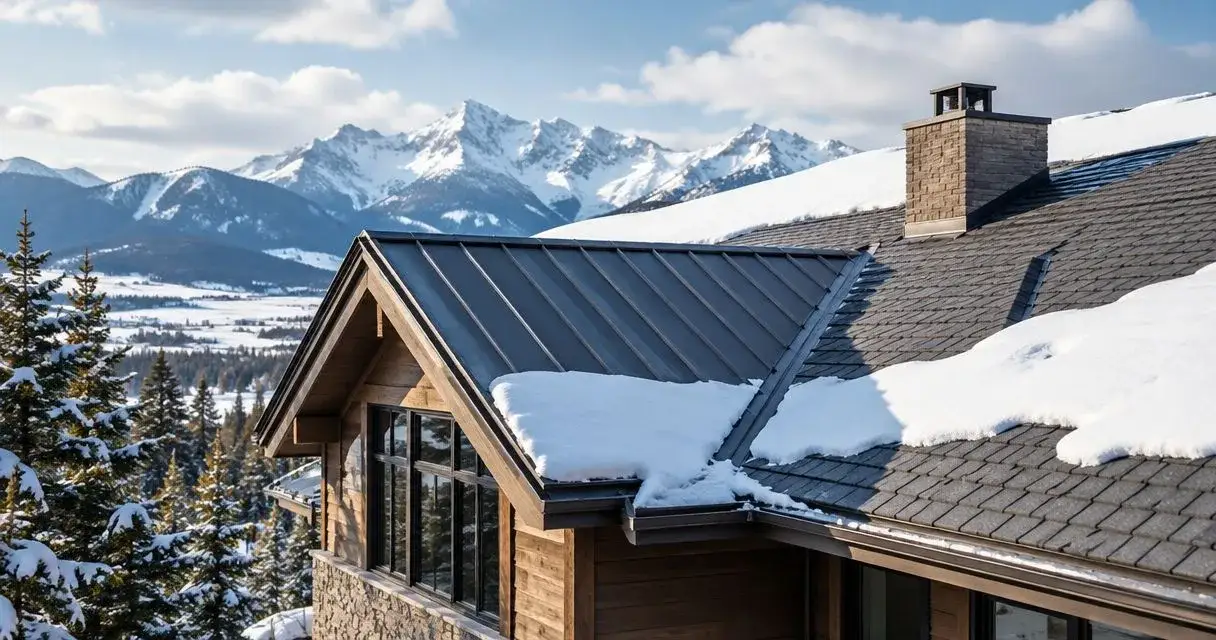
Best overall: standing-seam metal. Best for conventional shingle replacement: architectural asphalt. Best for accessible outbuildings: exposed-fastener metal. Best for the look of wood or slate without the weight: synthetic shake and slate from DaVinci or Brava. Best for authentic wood character on a maintained roof: cedar shake, including fire-treated options. This guide compares the best roofing materials for Montana snow and wind so you can discuss the right roof assembly with the residential roofing team at Ace Roofing.
TL;DR
- For the best roofing materials for Montana snow and wind, standing-seam metal is the default shortlist leader.
- Architectural asphalt suits conventional shingle replacement; select the exact product by tested wind classification and installation requirements.
- Synthetic shake and slate from DaVinci or Brava give wood and stone looks at far less weight than quarried slate.
- Cedar shake, including fire-treated options, suits homeowners who accept a real maintenance commitment.
- Snow loads, wind uplift, ice dams, and snow shedding require separate design decisions.
Why this matters
A roof covering does not establish how much snow your house can support. Rafters, trusses, decking, connections, and the building’s design loads determine structural capacity; the covering must work within that assembly.
Wind creates a different problem: uplift can loosen coverings and connections, especially near roof edges and corners. Ice dams add another failure path by backing meltwater beneath the covering. Choose a complete roof assembly, not a material with a winter-weather reputation.
For homeowners comparing roofing materials, Ace Roofing’s guide puts standing-seam metal first when the assembly addresses uplift and sliding snow. That verdict does not replace a site-specific structural or installation assessment.
What makes the best roofing material for Montana?
Use these criteria to judge any roof proposal before comparing appearances:
- Structural fit: Confirm that the building supports the proposed assembly and its required design loads.
- Wind resistance: Request documentation for the exact covering, deck attachment, fasteners, and edge details — not a generic material claim.
- Snow management: Decide where snow can remain and where sliding snow threatens doors, paths, equipment, or lower roofs.
- Water protection: Specify underlayment, ice-barrier details, valleys, flashing, and penetrations as part of the work.
- Roof geometry: Match the system to the actual slope, roof length, valleys, dormers, and transitions.
- Maintenance access: Choose an assembly whose inspection and repair needs you can support safely.
Roofing materials at a glance
Ace Roofing works within a defined set of roofing materials; the full range is detailed on the roofing materials and products page. Here is how the five options compare:
| Roofing material | Best for | Standout feature | Key limitation |
|---|---|---|---|
| Standing-seam metal | Homes needing concealed fastening and planned snow management | Raised seams with concealed attachment in typical systems | Sliding snow and thermal movement require deliberate detailing |
| Architectural asphalt | Conventional shingle replacement | Individual shingles can be replaced during localized repairs | Wind performance depends on product classification, fastening, and sealing |
| Exposed-fastener metal | Accessible outbuildings | Through-fastened panels with visible attachment points | Exposed fasteners and washers require inspection |
| Synthetic shake and slate (DaVinci, Brava) | The look of wood or stone without the weight | Molded shake and slate profiles in engineered material | Wind and impact performance are product-specific; verify the manufacturer’s documentation |
| Cedar shake (including fire-treated) | Authentic wood character on a maintained roof | Natural texture that deepens as the roof weathers | Regular cleaning, treatment, and repair; fire treatment is not fireproofing |
No entry wins every criterion. Standing-seam metal leads this shortlist because concealed attachment and raised seams offer useful design advantages, but an unsuitable panel system or poor flashing can erase those advantages.
1. Standing-seam metal: best roofing for planned snow management
Standing-seam metal uses panels joined at raised seams. Typical systems conceal the attachment beneath the panels, reducing exposed fastening penetrations across the roof surface.
The material suits a coordinated approach to winter roofing: panel attachment, thermal movement, snow retention, and drainage all need specifications. Smooth metal can release snow in sheets, so a roof that sheds snow is not automatically safer around entrances.
Standing-seam metal pros:
- Concealed attachment reduces exposed fastener penetrations in typical systems.
- Raised seams keep panel joints above the main drainage surface.
- Compatible snow-retention systems can be incorporated into the design.
Standing-seam metal cons:
- Sliding snow can endanger people and damage objects below.
- Seam profiles have different slope and weather-resistance requirements.
- Flashing, clip selection, and thermal movement require careful detailing.
Best for: Homes where the roof design includes documented wind-uplift resistance and a snow-retention plan.
Ask which seam profile is proposed and whether the manufacturer permits it at your measured slope. Also ask how the installer will attach snow retention without compromising panel movement or weather protection.
Verdict: Buy standing-seam metal when the proposal specifies the assembly and controls snow discharge.
2. Architectural asphalt: best roofing for shingle replacement
Architectural asphalt shingles are overlapping, laminated roof coverings fastened to a roof deck. They provide a familiar replacement route for an existing shingle roof without introducing a fundamentally different covering system.
Ace Roofing installs architectural asphalt as a GAF Master Elite contractor, an Owens Corning Platinum Preferred Contractor, and a Malarkey Emerald Premium Contractor. A manufacturer certification signals that the installer meets that maker’s program requirements — it does not replace written documentation of the exact product, deck repairs, fastening, and winter installation procedures on your roof.
Wind resistance is product-specific. Nail location, nail count, deck condition, starter installation, edge details, and shingle sealing all affect the finished roof; a label alone does not establish installation quality.
Architectural asphalt pros:
- Individual damaged shingles can be replaced during localized repairs.
- The covering works with conventional sloped-roof construction.
- Published product instructions provide specific fastening and underlayment requirements.
Architectural asphalt cons:
- Incorrect fastening or incomplete sealing undermines wind resistance.
- Retaining snow on the surface does not increase structural snow capacity.
- Ice-dam protection still depends on the underlying roof assembly.
Best for: Homeowners replacing shingles who want to retain that roof-covering approach.
Distinguish wind classification from impact classification. ASTM D7158 and ASTM D3161 address asphalt-shingle wind performance through different test methods; UL 2218 addresses impact resistance. An impact classification is not a snow-load rating. If hail sits high on your list, our guide to the best impact-resistant shingles for hail damage protection covers that decision in detail.
Verdict: Buy architectural asphalt when the exact product, deck repairs, fastening, and winter installation procedures are documented.
3. Exposed-fastener metal: best roofing for accessible outbuildings
Exposed-fastener metal panels attach through the panel face, typically using screws with sealing washers. Those visible attachment points distinguish the system from concealed-fastener standing seam.
This option belongs on the shortlist for an outbuilding where you can arrange regular inspection and maintenance. Do not treat a barn, workshop, or garage as exempt from structural snow-load or wind-uplift requirements.
Exposed-fastener metal pros:
- Visible fasteners make attachment locations identifiable during inspection.
- Panel profiles provide direct drainage paths when properly installed.
- Individual fastening issues can be addressed through a planned maintenance process.
Exposed-fastener metal cons:
- Fastener penetrations depend on correctly installed sealing components.
- Loose screws, damaged washers, and panel movement require attention.
- Sliding snow still needs a discharge or retention plan.
Best for: Outbuildings with straightforward roof geometry and practical inspection access.
Ask for the specified screw type, attachment substrate, spacing, lap details, and maintenance instructions. A panel name without its fastening schedule is not a complete wind-resistance specification.
Do not choose exposed fastening simply because a roof is metal. It creates a different maintenance obligation from concealed attachment, and that distinction belongs in your decision.
Verdict: Buy exposed-fastener metal for suitable outbuildings; skip it if the decision assumes no future fastener maintenance.
4. Synthetic shake and slate: best for wood or stone looks without the weight
Synthetic shake and slate are engineered tiles molded from the profiles of natural cedar shakes and quarried slate. Ace Roofing installs the DaVinci and Brava synthetic lines.
The appeal is practical. You get the texture and shadow lines of cedar or slate without the weight quarried stone adds to the structure or the upkeep bare wood demands. Individual tiles can typically be replaced during localized repairs, and color stays consistent from tile to tile.
Synthetic shake and slate pros:
- Engineered material does not rot, split, or feed the moss and decay cycles that drive cedar maintenance.
- Lighter than natural slate, which makes structural suitability easier to confirm.
- Molded profiles hold consistent color and shape across the whole roof.
Synthetic shake and slate cons:
- Wind and impact performance are product- and profile-specific; request the manufacturer’s published classifications for the exact tile.
- Fastening, flashing, and snow-retention attachment still require the same detailing discipline as any other covering.
- Slope minimums and installation requirements differ by product line, so the proposed profile must match your roof geometry.
Best for: Homeowners who want the cedar or slate look and will verify the exact product’s documentation.
Ask which DaVinci or Brava profile is proposed and confirm the manufacturer permits it at your measured slope. The wind-uplift and snow-management questions from the standing-seam section apply unchanged.
Verdict: Buy synthetic shake or slate when the exact product, slope limits, attachment, and snow plan are documented.
5. Cedar shake: best for authentic wood character on a maintained roof
Cedar shake is a natural wood covering — thick, split shingles whose texture deepens as the roof weathers. It is the most traditional covering on this list and the one that asks the most of its owner.
Montana’s dry summers and fire-prone forest edges make fire performance a fair question. Fire-treated cedar shakes are impregnated with a fire retardant to improve how the wood performs near ignition sources. Treatment changes the fire behavior of the wood; it does not make the roof fireproof, and local requirements, the full roof assembly, and the vegetation around the building still decide the outcome. Our guide to cedar shake roofing options for fire-prone areas works through that decision in detail.
Cedar shake pros:
- Genuine wood texture and character that no manufactured product fully reproduces.
- Individual shakes can be replaced during localized repairs.
- Handles freeze-thaw cycles well when flashing, ventilation, and drainage are detailed correctly.
Cedar shake cons:
- Needs regular cleaning and treatment to manage moss, rot, and weathering — more upkeep than any other covering here.
- Shaded valleys and north-facing slopes age faster and weather unevenly.
- Fire treatment must be verified against the specific product and adopted local requirements.
Best for: Homeowners who want real wood and will commit to the maintenance schedule.
Ask how the installer will detail valleys, eaves, and snow-retention attachment, and what the written maintenance plan includes. A cedar roof without a maintenance plan is a cedar roof aging on its own.
Verdict: Buy cedar shake when you accept the maintenance commitment; choose synthetic shake if you want the look without the work.
Check slope, snow load, and ice protection separately
Roof slope limits the systems you can specify. Under the International Residential Code’s model provisions, asphalt shingles require a slope of at least 2 inches of rise per 12 inches of horizontal run. Slopes below 4 inches of rise per 12 inches of run require the code’s specified low-slope underlayment treatment; confirm the adopted local requirements and product instructions.
Ice-barrier requirements are separate. Where the model code requires an ice barrier, its roof coverage extends to at least 24 inches inside the exterior wall line. That is not the same as measuring a fixed distance up the roof from the gutter.
Use this sequence:
- Measure slope: Record each roof plane, including additions and porch roofs.
- Verify loads: Confirm applicable snow and wind design requirements with the local building authority and design professional.
- Specify protection: Document underlayment, ice barriers, flashing, ventilation, and drainage.
- Plan snow: Identify discharge hazards and design retention where needed.
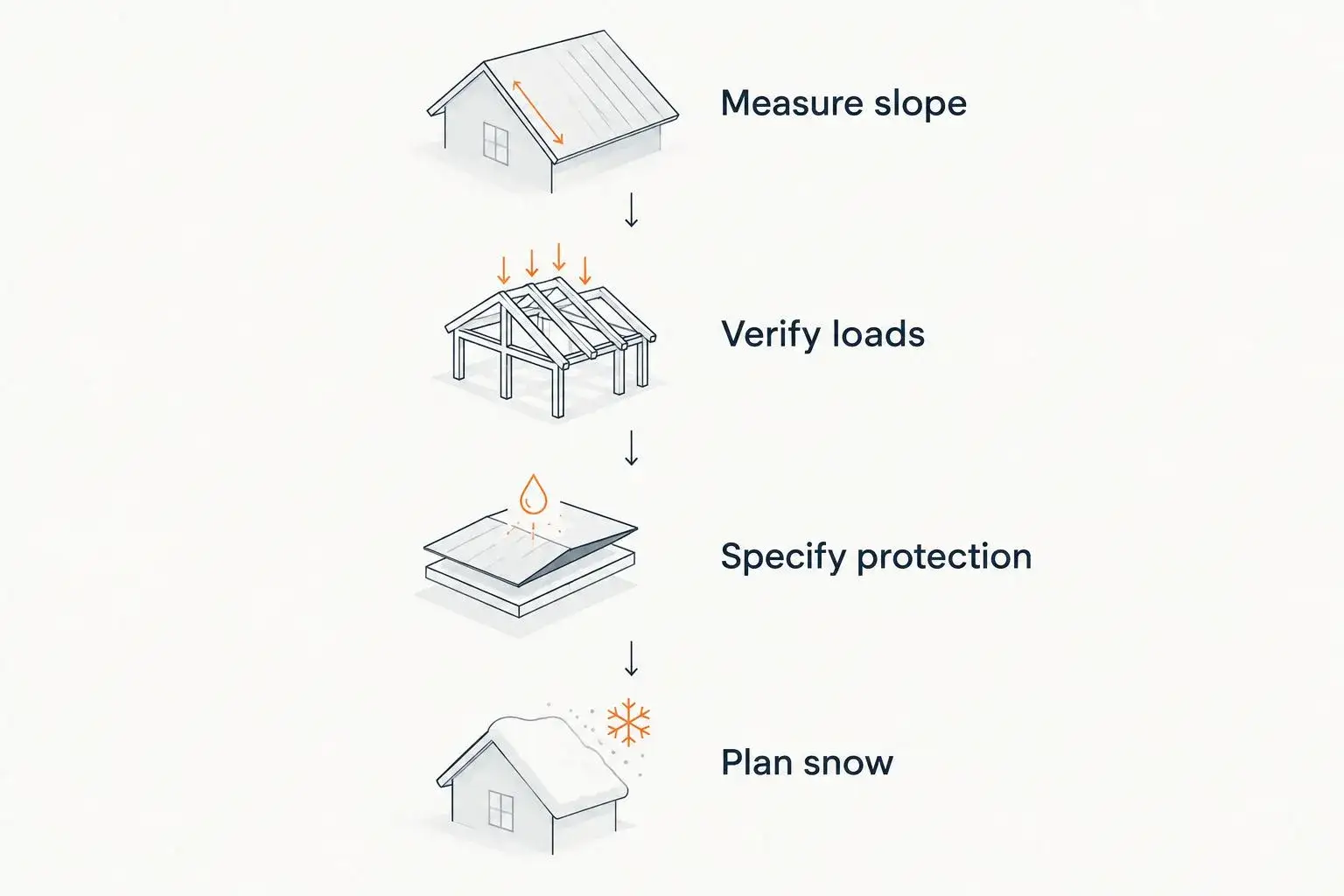
Choose the covering after the roof’s structural and water-management requirements are established.
Ice dams need more than a different surface material. Heat escaping into the attic can melt roof snow, which then refreezes near colder eaves. Address air leakage, insulation, and ventilation alongside the roof covering; an ice barrier limits water intrusion but does not remove the underlying heat-loss problem.
What a usable roof proposal must explain
Ask for a written scope that lets you compare assemblies rather than sales descriptions. Your proposal should identify:
- Deck condition: Inspection, replacement criteria, and attachment requirements.
- Covering specification: Manufacturer, product, profile, and applicable installation instructions.
- Wind details: Fasteners, attachment pattern, edge treatment, and relevant tested classifications.
- Water details: Underlayment, ice-barrier extent, valleys, penetrations, and flashing replacement.
- Snow details: Retention locations, attachment method, and areas exposed to discharge.
- Maintenance: Inspection needs and material-specific repair procedures.
Bring these questions to your roofing project discussion with Ace Roofing, whether your roof is in Bozeman or anywhere else in Montana. Keep the conversation tied to your building: slope, exposure, roof geometry, and discharge zones — not a generic claim that one material handles every Montana winter.
How these materials rank
The ranking prioritizes structural fit, wind attachment, snow management, water protection, geometry, and maintenance. Standing-seam metal leads as the default shortlist choice; architectural asphalt, exposed-fastener metal, synthetic shake and slate, and cedar shake each serve a different use case.
This is a material-selection framework, not a product test or a certification of an individual roof. A correctly specified alternative beats a poorly detailed first-place material.
Which roofing material should you choose?
Start with standing-seam metal if you want concealed fastening and can incorporate snow retention into the roof design. Choose architectural asphalt for conventional shingle replacement, exposed-fastener metal for maintainable outbuildings, synthetic shake or slate for the wood or stone look with less upkeep, and cedar shake if authentic wood is worth the maintenance to you.
Reject proposals that name a covering but leave attachment, flashing, and snow management undefined. Those details determine whether the material’s advantages reach your roof.
FAQ
What’s the best roofing material for Montana snow and wind?
Standing-seam metal is the default shortlist choice when its attachment, flashing, and snow-retention system suit the building. Architectural asphalt is a practical alternative for conventional shingle replacement.
Is a metal roof stronger under snow than asphalt shingles?
A metal covering does not by itself increase the building’s structural snow capacity. Rafters, trusses, decking, connections, and the complete design determine what the roof can support.
Should a Montana roof shed snow or hold it?
The right approach depends on where snow would fall and how the building is designed. Snow retention needs engineered attachment where sliding snow threatens entrances, walkways, equipment, or lower roofs.
Do impact-resistant shingles also resist high winds?
Impact resistance and wind resistance are separate classifications. Check the exact shingle’s wind documentation and installation requirements rather than treating an impact rating as proof of wind performance.
Will a metal roof prevent ice dams?
A metal roof does not eliminate the conditions that cause ice dams. Air leakage, insulation, ventilation, roof geometry, and water-protection details still need attention.
Is synthetic slate the same as natural slate?
No. Synthetic slate is an engineered tile molded from the profile of quarried slate, while natural slate is split stone. Synthetic products are lighter, and their slope limits, fastening, and classifications still need the manufacturer’s documentation.
Are fire-treated cedar shakes fireproof?
No. Fire treatment improves how cedar performs near ignition sources but does not make the roof fireproof. Verify the specific product’s treatment documentation and adopted local requirements before deciding.
What should I ask a roofing contractor before choosing a material?
Ask for the exact covering, slope requirements, attachment details, water-protection scope, and snow-management plan. Ace Roofing’s roofing-material guide uses those details to distinguish a complete proposal from a material-only recommendation.
One last thing
Mark every place you stand beneath an eave: the front door, garage entrance, side gate, and equipment access. A roof can protect the building while creating a snow-drop hazard directly outside it. Include those locations in the design discussion before you approve the covering.
Ready to compare these materials on your actual roof? Start with a free instant roof quote and bring your slope, exposure, and snow-discharge questions to the conversation.